.svg)
Science vs Art in Compensation: Balancing Data and Business Judgment
60% of companies link pay to performance, but data alone isn't enough. Learn how to blend compensation science (metrics) with art (business context) for fair, flexible decisions.

While 60% of companies now tie pay directly to performance metrics, structured data alone doesn't create great compensation programs. The most effective approaches blend rigorous analytics with real-world business judgment, science meets art.
This guide explores how to balance data-driven fairness with contextual flexibility for compensation decisions that drive retention and results.
Science vs. Art in Compensation
As your company expands, having an effective compensation program becomes essential to motivate and recognize talents.
Science = Objective metrics that ensure consistency and reduce bias:
- Compa-ratios (current pay ÷ range midpoint)
- Performance ratings linked to increase guidelines
- Pay equity analysis across peer groups
- Tenure, potential, and market benchmarks
These create explainable, defensible decisions employees can trust.
Art = Business context and judgment that data can't capture:
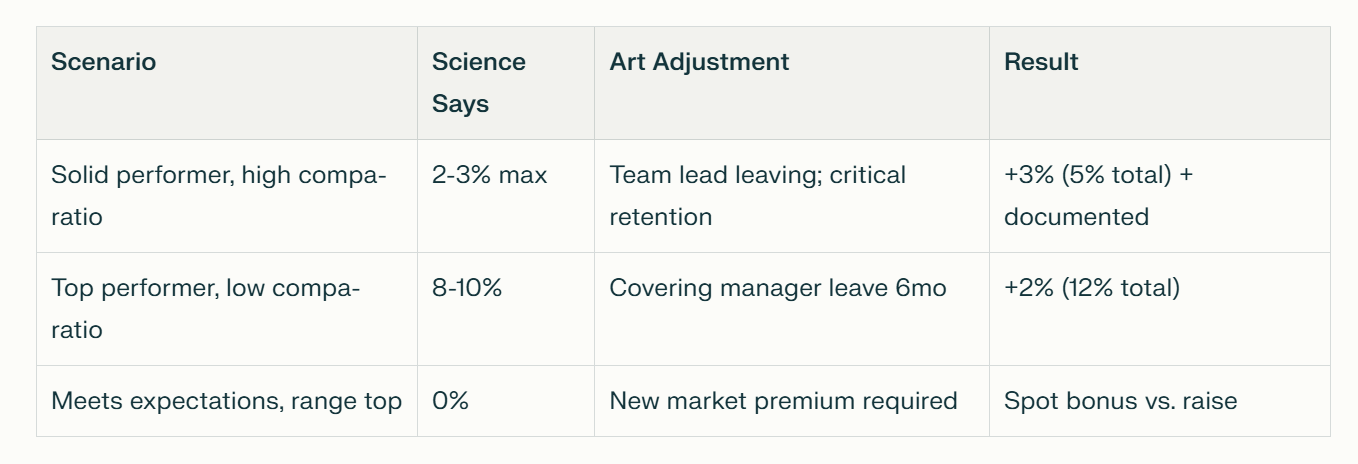
- Team dynamics (e.g., covering for maternity leave)
- Retention risks (key player when others are leaving)
- Market shifts (sudden talent scarcity)
- Business priorities (team's role in current strategy)
Managers do have some leeway to decide by taking both data points and their business knowledge/external context.
Why Balance Matters
In every compensation philosophy, a structure is established to reduce bias, unjustified gaps and provide trust in the decision-making process. Pay increases can be tied to performance ratings and compa ratio, etc.
However, it is also relevant to take other factors to put into prospective the data before making conclusions: business insights, team size, internal dynamics, labor market, etc.
- For instance, specific team contexts like manager maternity leaves can justify decisions to grant pay raises within the team to anticipate higher workload, even if it is outside standard guidelines (employee compa ratio already high, performance within range, etc.).
- An employee whose performance is satisfactory, without being outstanding, may receive an increase if this person becomes key to retain in the near future because everyone else in the team is leaving.
“Compensation decisions are a mix between art and science: data should be read and analysed together with business insights and team’s context, in order to take the best compensation decision that is also commercially right for the business.” Erica Lauretta, Head of Rewards
Whatever the case, being able to justify the rational with both data-driven and business criteria is essential in compensation decisions. In conjuction, providing training on compensation metrics and giving flexibility when deciding on raises are key points to better involve managers in your recurring events.
Structuring Science & Art
Compensation is both a science and an art that needs to be structured based on one company’s context. Below are a few non-exhaustive examples of how to promote a fair and flexible compensation philosophy.
1. Embed Context in Your Philosophy
Expansion, new strategy or unexpected changes can occur to a business. Thus, it is key to incorporate the latest business insights and reflect them in updated rewards practices.
2. Annual Business Context Refresh
Providing clarity on how jobs mean in your organization and how to compare them is critical to assess decisions and provide relevant insights. Updating them and reviewing your compensation ranges becomes essential during each stage of growth.
3. Separate Performance from Pay Conversations
It is important to provide separate events to talk about development aspirations in relation with business opportunities (usually within the performance review). Then compensation items can be dealt more precisely within the compensation review. This allows managers to take the employee’s inputs and ensure fairness during the decision-making process, while allowing more time to assess performance used for compensation guidelines.
4. Manager Enablement Framework
Communication is core to any compensation program’s success, all stakeholders including leadership, managers, employees should be aware of how decisions are made and processes within main events. Manager’s ownership can be provided through dedicated training, especially when dealing with compensation topics.
Communication That Builds Trust
Promoting the right practices will push a fair compensation strategy. With a structured compensation philosophy that mixes science and art, your company will progress towards consistent results and thus, will better recognize your employees.
Leadership: "Our guidelines ensure fairness; exceptions reward impact."
Managers: "Your 7% reflects strong performance + team's critical role this quarter."
Employees: Data + story = understanding, even if disappointed.
Scale with the Right Tools
Manual processes break at 100+ employees. A compensation platform delivers:
- Automated matrix calculations
- Exception tracking and approvals
- Real-time equity dashboards
- Audit-ready rationale documentation
Elevate your total rewards
processes



Heyquity is a compensation platform for rewards and compensation teams built to support consistent compensation processes while ensuring pay equity across locations.